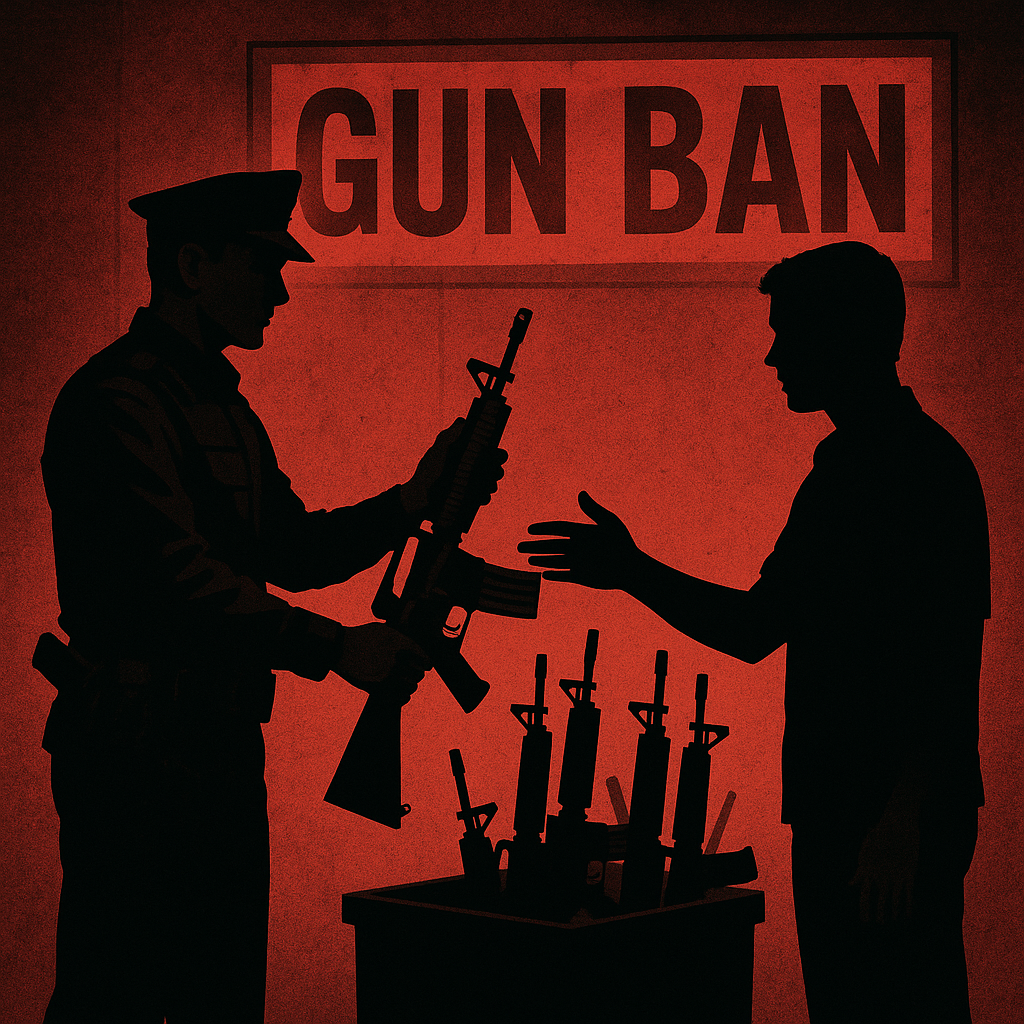
I’ve always found it fascinating to ask the big “what if” questions about our country. One of the biggest has to be this: What if America decided to ban private gun ownership outright? It’s a hypothetical that’s raised in political debates all the time, usually followed by that old saying: “If you criminalize guns, only criminals will have guns.”
So let’s break it down. Could it ever actually happen, and if so, how would it play out?
The Constitutional Roadblock
The Second Amendment is the bedrock of gun rights in the U.S. Courts have reinforced it again and again, most famously in District of Columbia v. Heller and Bruen. To ban guns completely, the government would likely need to repeal or radically alter the Second Amendment itself.
And that’s no small task. You’d need two-thirds of Congress plus three-fourths of state legislatures to agree. In today’s political climate, with red states and blue states already at each other’s throats, this step alone is almost unthinkable.
But let’s pretend for a moment that it happened. What next?
Step-by-Step Scenario of a Gun Ban
If Washington somehow cleared the legal hurdles, here’s how the process might unfold:
- Mandatory Registration
Every firearm in circulation would need to be registered with the federal government. Without a registry, there’s no way to know who has what. Of course, this step alone would spark massive resistance. - Buyback Program
The government would likely launch a national “buyback,” offering money for each firearm turned in. Australia did something like this in the 1990s, but the U.S. has over 400 million firearms — many times more than Australia ever faced. - Phased Prohibition
A law might allow existing owners to keep their guns for a set period, but ban new sales. Over time, the supply would theoretically shrink as guns aged out. The problem? Guns are incredibly durable — many last for decades. - Criminal Penalties for Possession
Eventually, owning an unregistered or prohibited firearm would become a crime. Law-abiding citizens would feel the heat, while criminals would continue to operate outside the law. - Enforcement Arm
At this point, the government would need boots on the ground — federal agencies or local police tasked with confiscation. But would every sheriff in Texas, Oklahoma, or Montana go along with that? Unlikely. Some states would flat-out refuse.
The Criminal vs. Citizen Problem
This is where the saying comes back into play. If the law-abiding turn in their firearms, and criminals don’t, the balance shifts. Black markets thrive on prohibition. Just look at alcohol in the 1920s or drugs today — bans don’t erase demand; they simply drive it underground.
Firearms could be smuggled across borders, bought illegally, or even 3D-printed. Meanwhile, the folks who did comply would be left defenseless.
Is It Too Late for America?
Honestly, yes. The sheer scale makes it nearly impossible.
- We’re talking about 400+ million guns already out there.
- Guns last for generations.
- Cultural identity and political geography make compliance spotty at best.
Even if a ban were passed tomorrow, many Americans simply would not comply. Some states would outright ignore federal orders. The country could easily splinter into a patchwork of “gun-free” states and “gun-friendly” states, creating more division than unity.
The Realistic Path Forward
Instead of fantasizing about outright bans, the more realistic path is regulation and harm reduction. Things like universal background checks, licensing systems, red-flag laws, or mandatory training might not please everyone, but they’re more enforceable than an impossible confiscation campaign.
Final Thoughts
If America ever tried to ban guns, the process would be long, bitter, and almost certainly ineffective. The truth is, we’re too far down the road. With hundreds of millions of firearms in circulation and a culture that fiercely protects them, a full ban is essentially off the table.
That old saying isn’t just rhetoric — it’s reality. If we criminalized guns tomorrow, the people who kept them would overwhelmingly be those already willing to break the law. And that leaves us with a hard truth: the U.S. can only manage gun ownership, not erase it.
About the Author

Mister San-Marcos is a resident of the great state of Texas and considers himself a strategic thinker on all topics. Politically, you’ll find him to be more right-leaning, but not too far. He has lived a wonderful life and a successful career and is now focusing his time on sharing his thoughts and recommendations to the world.