“Be careful what you wish for.”
It’s one of those old sayings that never really goes out of style — and lately, it feels like America could use a refresher.
We live in a time when it’s fashionable to demand sweeping “transformative” policies, where slogans replace solutions and feelings often outrun facts. Each policy sounds good in isolation — who doesn’t want compassion, fairness, or inclusion? — but when stacked on top of each other and implemented on a large scale, they can start to look less like progress and more like anarchy with better branding.
So, let’s imagine a world where progressives get everything they’ve asked for — every lofty policy, every social experiment, and every utopian promise. What does that actually look like?
1. Open Borders — Closed Logic
Let’s start with the mother of all progressive dreams: open borders. Tear down the walls, scrap ICE and the Border Patrol, and throw away the immigration forms. Everyone, from anywhere, for any reason — welcome! It’s the ultimate symbol of inclusion, right? A single global commune where “nationality” is just a colonial construct and sovereignty is an outdated concept.
There’s only one small hiccup. No modern country on Earth actually has open borders. Not one. From Canada to Kenya, from Sweden to Singapore, every functioning nation — big or small, rich or poor — manages its borders in some form. Even the famously liberal nations of Western Europe monitor who enters and exits with electronic precision. The European Union’s Schengen Area allows visa‑free travel among member states, but even that comes with passports, registration, and the power to suspend entry when things go sideways. Ask anyone who tried to cross from France into Switzerland during the pandemic — the “open” part shuts pretty fast.
Why? Because every government on Earth knows that borders aren’t about cruelty; they’re about control — of health, security, jobs, and basic economics. Without them, chaos replaces structure. The only places that even resemble open borders today are failed states — territories so unstable that nobody’s minding the gate because there’s no one left to do it. Think war zones, not utopias.
Yet, somehow, American activists insist that if we do it, things will magically work out fine. Millions could come and go without oversight, and we’re supposed to believe hospitals, schools, and infrastructure will miraculously handle it. We already struggle to manage our current systems — how would we survive turning every city into a migration checkpoint with no oversight at all?
The irony runs deep: the same leaders lecturing about sustainability want to import an unlimited population into a system already bursting at the seams. Without borders, citizenship loses meaning, law enforcement loses jurisdiction, and welfare programs buckle under infinite demand. It’s not compassion — it’s wishful thinking with a passport stamp.
So yes, let’s be bold. Let’s do something no functioning nation has ever dared because they all learned the lesson the hard way: a country without borders isn’t compassionate — it just stops being a country.
2. Housing for All (Anywhere You Want)
With millions of people flooding in, demand for housing hits the stratosphere. But telling someone “no” is oppressive, right? So the next compassionate move: let people live wherever they want.
Tents, sidewalks, parks — your front yard. Every patch of concrete becomes potential “affordable housing.” Meanwhile, the middle class invests in locks, fences, and fortitude.
Homelessness stops being a social issue and becomes the social norm. Property rights evaporate. Why buy when you can squat?
And when property owners try to reclaim their land, they’re branded as heartless. Society celebrates empathy — at least until the encampments spread to their own neighborhoods. Just ask the homeowners of Martha’s Vineyard.
3. Compassion by Chaos: Legalized Drug Use
Next comes the crown jewel of compassion politics: turning drug use into a public lifestyle choice. “Addiction,” they say, “is a health issue, not a crime.” Fair enough — treatment matters. But under this new model, “treatment” quietly becomes “tolerance,” and instead of rehab centers, we get open‑air drug markets.
Cities following this grand experiment — Portland, San Francisco, Seattle — already provide free needles, safe‑use kits, and even tents. Parks become pharmacies without licenses. Sidewalks turn into triage fields. And as addiction blooms unchecked, taxpayers pick up the tab for everything that follows: emergency calls, ambulance rides, detox admissions that last 24 hours before discharge, and endless rounds of medication for recurring overdoses.
Hospitals become revolving doors. ERs buckle under the constant stream of overdoses, infections, and withdrawal crises. Doctors and nurses who once focused on treating heart attacks and trauma now spend half their shifts reviving the same addicts — sometimes multiple times a day. Public budgets meant for community health care, cancer screenings, and pediatric clinics are drained to fund endless emergency responses. And when the system groans under the strain, cities just ask for more federal money, as though compassion can be bought by the barrel.
Meanwhile, productive citizens — the ones paying for it all — wait longer for treatment, pay higher premiums, and watch their local hospitals edge toward insolvency. It’s not just compassion fatigue; it’s infrastructure collapse disguised as empathy.
And so, in this grand gesture of human kindness, we wind up with a paradox: a society that claims to care so deeply for the addicted that it enables their addiction, bankrupts its hospitals, and punishes the very doctors trying to hold the line.
That’s not public health. That’s public unraveling.
4. Theft Under $1,000: The New Coupon System
Among the brightest gems of our imagined utopia is the new moral math: if it’s under $1,000, it’s not a crime — it’s just “redistribution.” Who needs burglary laws when you’ve got compassion quotas? Police? They’ve got better things to do, like filling out paperwork no one will read.
And we don’t even have to imagine what that looks like — just ask San Francisco. After the city downgraded many thefts to misdemeanors and quietly encouraged prosecutors to “prioritize compassion,” entire retail chains fled downtown. Walgreens and Target shuttered multiple stores. Videos of people sauntering out with armfuls of merchandise went viral — not because anyone was shocked anymore, but because nobody even tried to stop them. Security guards just stood there filming, since tackling a thief now risks a lawsuit.
What started as leniency became a lifestyle. Thieves learned the system fast: keep each haul under the magic $950 line and you get unlimited free shopping trips. Organized groups hit store after store like retail relay teams, tagging in their friends once they reached the legal limit. Shoppers clutch their purses a little tighter, employees count the days until layoffs, and honest customers pay higher prices to offset the losses. Equality at last — everyone’s equally inconvenienced.
This is what happens when feelings replace enforcement. Once stealing becomes “understandable,” order collapses and crime normalizes. Businesses don’t close because of greed; they close because the law abdicated. Compassion without consequence turns cities into self‑checkout zones for criminals.
The result? The poor lose access to essential goods, while small business owners — often minorities — lose everything. Equality! Everyone’s equally broke.
5. The Criminal Reset Button
In our idealized new justice system, punishment is old-fashioned, deterrence is outdated, and forgiveness is automatic. Every crime gets a fresh start, every arrest a clean slate. Forget “innocent until proven guilty” — now it’s “innocent, even after proven guilty.”
Take Illinois, for instance. In 2023, the state expanded its policies to automatically seal certain criminal records, even for individuals with repeated offenses, all in the name of “restorative justice.” The reasoning? People deserve second chances. Fair enough — most reasonable folks agree with that. But when a system decides that third, fourth, and fifth chances should all come with zero transparency, you no longer have justice, you have roulette.
Picture this: a man applies for a job as a bank teller — a position that handles cash, personal data, and security-sensitive tasks. His background check comes back spotless. Employers breathe easy, HR signs off, and the company proudly posts about its commitment to “equity in hiring.” What they don’t know is that just a few years earlier, he’d been arrested three times for financial fraud — but each case was sealed under Illinois’ new policies, wiped from view as though they never happened.
Now imagine the outcome when he inevitably repeats his “mistake.” The bank loses money, customers lose trust, and lawmakers express shock — again — that a system built on pretending crimes didn’t happen failed to predict crime. But really, who needs foresight when you have feelings?
Here’s the dark comedy in it all: this kind of policy doesn’t just erase the record; it erases accountability. Employers can’t protect themselves, law enforcement loses the ability to identify repeat offenders, and ordinary citizens are left assuming everything is fine — because the paperwork says so. The resume is clean, the background check is clear, and the danger is invisible.
The moral? A fresh start is valuable only when paired with responsibility. But in the new America, there’s no such thing as consequence — only endless restarts. It’s justice as a video game, and everyone gets unlimited lives.
6. The Welfare Wonderland
To fix all this, the government expands social programs into infinity. Food, housing, income, medical care — all free. Because compassion, of course.
Billions flow into government‑approved charities and “community organizations,” most of which thrive on not solving the problems they exist for. The middle class foots the bill, inflation roars, and yet somehow no one’s any better off.
When everyone gets “help,” no one gets self‑reliance. Dependency stops being a consequence — it’s the goal.
7. Driver’s Licenses for Everyone — Knowledge Optional
Because fairness must always come first, the next logical step is making sure everyone gets a driver’s license — no tests, no English, no pesky knowledge of traffic laws required. After all, rules can be “discriminatory,” right? Why should a written exam stand between someone and two tons of steel moving at 70 miles per hour?
In this brave new world, the Department of Motor Vehicles becomes the Department of Moral Victories. Pass/fail grading is replaced by participation stickers, and the only unacceptable answer on the test is “no.” Driving isn’t a privilege anymore; it’s a human right — even if the humans behind the wheel can’t read a stop sign.
Picture this: intersections where every light flashes red, yellow, and green at once because no one remembers what they mean. Insurance companies triple their rates — assuming they haven’t fled the country yet. Fender‑benders become freeway pileups, and accidents become so common that we stop calling them accidents. They’re just “transportation events.”
And let’s not forget enforcement — or what’s left of it. With police departments gutted and traffic laws declared “inequitable,” who’s going to pull anyone over? Speed limits turn into suggestions. Hit‑and‑run becomes drive‑and‑shrug. Drunk? Distracted? No problem. After all, who are we to judge — or ticket — someone’s personal driving style?
This is what happens when equality is confused with entitlement. Real equality means everyone faces the same rules. False equality means no one has any. Without standards, roads stop being paths of progress and turn into demolition derbies in the name of diversity.
8. Identity Without Limits — and You’re Paying
In the utopian world of unrestrained self‑expression, identity is no longer rooted in biology, reality, or even common sense — it’s purely a matter of declaration. “Be who you are” becomes “be whatever you say,” and everyone else must not only agree but celebrate it. Questioning someone’s self‑definition — even accidentally — is practically treason.
Need hormone therapy, surgery, or any procedure to align your physical form with your inner perception? Don’t worry; taxpayers have it covered. The national motto quietly updates to: “E Pluribus Subsidium” — “Out of many, comes more funding.” Hospitals go bankrupt, insurance costs explode, and medical schools are told to prioritize sensitivity training over surgical skill. Because feelings, after all, are the new science.
And it doesn’t stop with gender. Once self‑definition becomes sacred law, everything’s on the table. Today you identify as non‑binary; tomorrow, as non‑human. Why not a wolfperson, or an elfkin, or a time‑traveler with dietary restrictions? Who are you to judge someone else’s “species expression”? Government forms multiply overnight — 42 pages of gender options, pronouns longer than small‑print mortgage contracts, and entire HR departments collapsing under the weight of inclusion audits.
What started as empathy becomes a bureaucratic labyrinth of mandated affirmation. Schools can’t teach pronouns fast enough, teachers are terrified to misgender a student, and universities scramble to rename departments (“The College of Fluid Human Experience and Interdimensional Studies,” perhaps). Sports teams are re‑rostered in real time, bathrooms lose all signage, and job postings carry legal disclaimers longer than the descriptions themselves.
Eventually, society grinds to a halt — not because of hate, but confusion. Communication collapses under the fear of saying the wrong thing. Medicine bends to ideology rather than biology. Debate dies. Facts fade. Language itself turns into an ever‑shifting minefield. The nation becomes less a country and more a therapy session with taxes.
And yes, we’ll pay for it — literally. Every operation, every new identity certificate, every government “adjustment program” comes out of the public wallet. Meanwhile, doctors walk away, educators burn out, and employers give up trying to balance inclusivity with functionality. Compassion mutates into coercion, and freedom of conscience becomes the one identity that’s no longer protected.
A society that erases its boundaries erases its sanity. When reality becomes optional, accountability follows it out the door — and what’s left is a culture more invested in how we feel about truth than in whether it exists.
9. Equality in Sports: When Biology Bows to Ideology
Sports is society’s meritocracy — until ideology rewrites the rules. In the name of inclusion, biological differences are thrown out the window, and women’s sports become a parody of themselves.
Athletic competition gives way to a social experiment in fairness theater, where winning isn’t celebrated — and losing isn’t fair.
Equality sounds great until it means pretending that sameness exists where it does not.
10. “Protest” Privilege: Violence Without Consequence
In the utopian script of boundless empathy, “protesting” has become the safest legal cover for chaos. Don’t like a policy, a company, or even your neighbor’s opinion? Grab a sign, light a fire, and call it activism. The louder and angrier, the better. Because these days, breaking windows is expression, and arson is awareness. Violence isn’t condemned — it’s curated for social media likes.
But let’s be honest. What we’re calling “protests” are often riots in dress shoes. Looting is justified as reparations, destruction as demonstration, intimidation as “activism.” The line between dissent and destruction is erased, and anyone who dares to point it out gets labeled as insensitive or authoritarian.
Meanwhile, police stand by — literally. In city after city, law enforcement officers are told to “stand down,” “de-escalate,” or “monitor from a distance.” Translation: watch the city burn and hope it ends before sunrise. Commanders weigh every action against potential accusations, lawsuits, or career-ending videos that might go viral before the smoke clears. Every cop knows that the wrong move — or even the right one — could make them next week’s national headline.
And who can blame them? In today’s climate, officers face an impossible paradox: enforce the law and risk becoming villains, or do nothing and watch society unravel. The result? Paralysis. Officers who once took pride in keeping order now count the days until early retirement. Departments are understaffed, demoralized, and frightened — not of criminals, but of the cameras waiting to catch them trying to do their jobs.
It’s not protest anymore; it’s performance art with gasoline and bricks. Downtowns become war zones, victims are treated as collateral, and mayors rush to the microphones to express “understanding” for the rage that flattened half their city. That’s not peace. That’s surrender wrapped in moral language.
This is what happens when sympathy replaces sanity — when fear of bad press outweighs the duty to protect the public. The mob has learned the secret: they don’t need to change laws to control society; they just have to scare the people who enforce them. Once the enforcers retreat, chaos doesn’t creep in — it runs the show.
And since arrests are passé, the mob rules. Rule of law dissolves into rule of rage, and everyone feels entitled to be judge, jury, and arsonist.
11. Disarm the Innocent, Empower the Criminal
In the utopian dream, guns are gone — or at least, that’s the promise. Nobody needs a firearm, the argument goes, because we’re all counting on peace, empathy, and better communication. “If we just take the guns away,” they say, “we’ll finally be safe.” Except we’ve also defunded the police, eliminated bail, and erased criminal records. So the only people left holding weapons are the very ones who shouldn’t have them.
Law-abiding citizens turn in their guns, clinging to the hope that society will protect them. But who exactly is that society now? Criminals, emboldened by a justice system that shrugs at their behavior, have no such moral hang-ups. They never followed laws in the first place. Gun bans don’t disarm criminals; they disarm victims. The result isn’t peace — it’s predator and prey, and the prey just handed over its defenses voluntarily.
And let’s talk about the messy reality of implementing this fantasy. If we have no police — the supposed enforcers of the law — then who collects the guns? Are we sending out social workers with tote bags to ask politely? Maybe an official “Gun Amnesty Volunteer Corps,” armed with nothing but clipboards and self-righteousness? They’ll knock politely while gangs trade firearms in the driveway behind them.
Or maybe we’ll rely on technology — registries, databases, or drones — to locate every gun owner in the country. Because if we’re already upending civil liberties, what’s a little domestic surveillance on the side? The irony is striking: the same movement that chants “defund the police” dreams of enforcing a law that would require more policing than any policy in modern history. Who’s going to confiscate 400 million firearms? Bureaucrats with megaphones? Activists with sternly worded pamphlets?
The truth is, a disarmed public doesn’t create safety — it creates submission. You can’t negotiate with criminals who don’t care about your laws, and you can’t reason with a mob that sees unarmed citizens as easy targets. With no law enforcement to step in, people become their own defensive plan — except they’ve already been told they’re not allowed one.
The final irony? The very same government that can’t keep track of public funds, guard the border, or control the streets is somehow expected to confiscate every weapon in the country — peacefully, of course. If that’s not a recipe for disaster, it’s at least a masterclass in magical thinking.
12. Everyone Gets to Vote — Even If They’re Not from Here
Now that everyone is free to enter, why not let everyone vote too? After all, if borders are “racist” and citizenship is “exclusionary,” then restricting voting rights must be oppression too — right?
In our brave new world, ballots are handed out like party flyers. You’re breathing? Congratulations — you’re a voter! Whether you just crossed the border yesterday or haven’t lived here long enough to know who your governor is, every opinion counts equally. Never mind that half the country might not even pay into the same system that their votes will control. That’s the new democracy — leadership by whoever shows up first.
And let’s be honest — it won’t stop there. Someone’s got to count all these ballots, manage the mailing lists, verify signatures, track the IDs (if we still have those). Except… wait. IDs are “voter suppression,” remember? The system now relies on the honor code. Which works perfectly — assuming millions of people suddenly become saints when politics are involved.
Of course, in this “inclusive democracy,” corruption quietly moves in. Ballot harvesting becomes common practice. Fake registrations flood the system. Political machines figure out how to “help” people vote correctly, often multiple times. And anyone who dares to question the process is branded as anti-democratic — for defending democracy.
Meanwhile, genuine citizens, who actually live, work, and pay taxes here, watch their votes shrink in value. When everyone votes, no one counts. Elections stop being about representation and turn into a popularity contest for whoever can organize chaos the fastest.
It’s the perfect ending to the progressive dream — a nation without borders, laws, or definition — where your voice doesn’t matter, because it’s drowned out by millions more that aren’t even supposed to be here. But hey, at least we’re inclusive.
The Final Picture: Compassion Without Limits, Chaos Without End
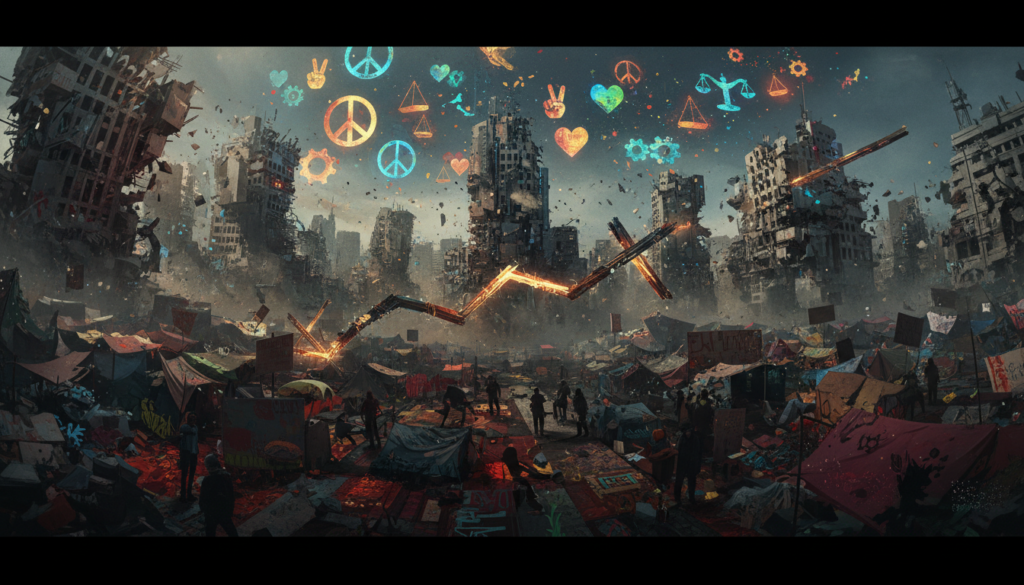
So here’s the grand finale of the progressive wish list — all the pieces we’ve collected along the way finally coming together. Each idea, taken alone, might sound decent enough. Who wouldn’t want to be compassionate? Who doesn’t want fairness, understanding, or opportunity? In isolation, they can seem noble, even inspiring.
But policy doesn’t live in isolation. It stacks, overlaps, and collides. Open borders collide with welfare expansion. Drug legalization collides with public health. De‑policing collides with disarmament. Each “good intention” tugs at another part of the system until everything comes apart at the seams.
The result isn’t utopia — it’s dysfunction dressed in moral language. It’s a country that works perfectly on paper and catastrophically in practice. Rules disappear, accountability dissolves, and freedom without structure devolves into lawlessness. Every safety net snaps.
We end up with a society where nothing is enforced, nothing is expected, and nothing works — not because people are evil, but because every compassionate idea was turned up to 11 without considering reality. The nation becomes a collage of contradictions: unlimited compassion, zero control; infinite freedom, no security; equality for all, justice for none.
The truth is, each individual idea might sound fine when whispered in a vacuum — but when shouted together, they drown out reason itself.
A world that tries to make everyone comfortable ends up comfortable only for chaos.
Be careful what you ask for. Because when every good idea becomes law at once, the country that enacts them won’t survive long enough to enjoy them.