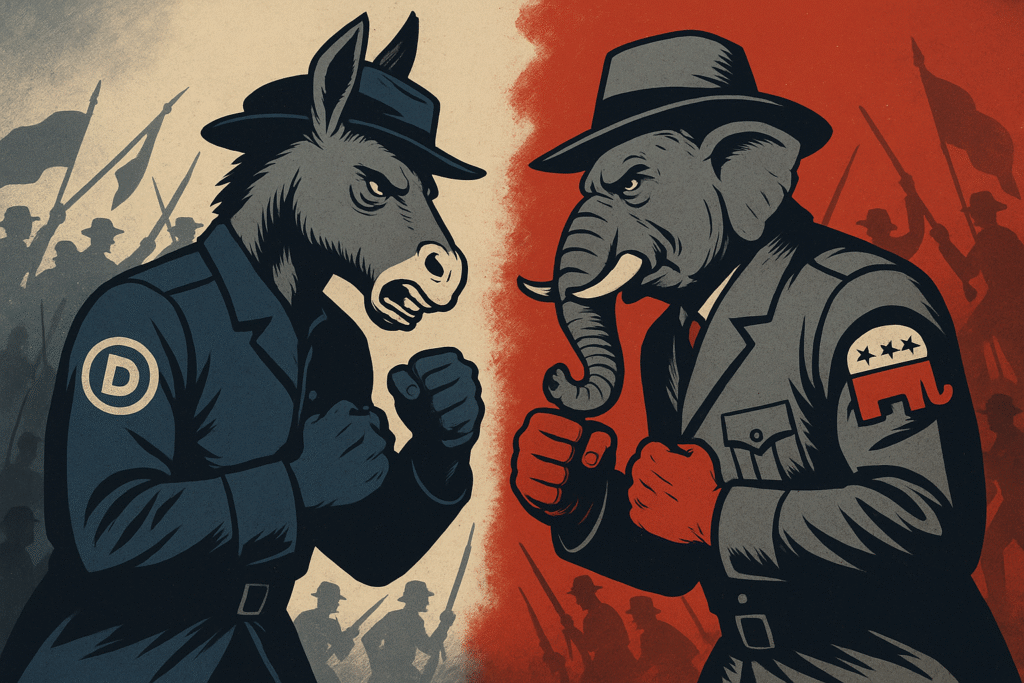
America is not facing a civil war like the one that tore the country apart in the 1860s, with cannons and battalions. But make no mistake—there is a civil war raging. It’s a cold war, not fought on battlefields but in legislatures, school boards, courtrooms, newsrooms, and social media feeds. It’s a war of ideology, identity, and culture. And it is slowly destroying our ability to function as one unified nation.
The divide between Democrats and Republicans is no longer just about policy differences. It’s about two visions for America that are so fundamentally different, they often appear incompatible. Whether it’s abortion rights, gun control, immigration, environmental policy, or education, the two major political parties in the United States are not just disagreeing—they are actively warring. And we, the people, are caught in the crossfire.
In this post, we will explore the roots of this modern civil war, how it manifests in everyday American life, and what, if anything, can be done to repair the fabric of our republic before it tears completely.
From Debate to Division—How We Got Here
America has always been a country of debate. The Founding Fathers argued fiercely over the Constitution, and political opponents in the 19th and 20th centuries fought bitterly over civil rights, economic policy, and war. But there was always a shared sense of nationhood—a belief that we were, despite our disagreements, still one people.
That started to erode in the late 20th century.
The Vietnam War and Civil Rights Movement exposed deep rifts in American identity. The Reagan era brought a sharp turn toward conservative economics and culture, while Bill Clinton’s presidency fueled a backlash that birthed the modern culture wars. The 2000 election and the controversy in Florida amplified mistrust in democratic processes. Then came 9/11, the wars in Iraq and Afghanistan, the financial crisis of 2008, and the election of Barack Obama, the nation’s first Black president.
Each of these moments added layers to the ideological divide. But it was the rise of social media, hyper-partisan cable news, and gerrymandering that turned these divisions into a virtual trench war.
The Battle Lines Are Everywhere
The red-blue divide is now woven into nearly every aspect of American life:
- Geography: Urban areas skew blue. Rural areas skew red. Even suburbs are battlegrounds.
- Media: Americans consume entirely different news ecosystems. Fox News vs. MSNBC. Daily Wire vs. NPR. Truth Social vs. Twitter.
- Values: What one side sees as progress (e.g., transgender rights), the other sees as moral decline. What one sees as patriotism, the other sees as nationalism.
- Trust: Democrats are more likely to trust science, higher education, and public institutions. Republicans are more likely to trust religious institutions, law enforcement, and the military.
This is no longer just political disagreement. It’s tribalism. It’s “us vs. them.” It’s viewing fellow Americans not as opponents but as enemies.
And it’s affecting our lives in dangerous ways. Friendships end over politics. Families are divided. People fear to speak honestly at work or in their communities. Violence is escalating—from the storming of the Capitol on January 6, 2021, to random attacks at school board meetings and campaign events.
The Real Cost of Our Political Civil War
While politicians on both sides score points on television, average Americans suffer the consequences. Government shutdowns, inflation relief gridlocks, crumbling infrastructure, healthcare access battles, and climate inaction—these are all symptoms of a paralyzed democracy.
The broader costs include:
- Democratic Erosion: Faith in our elections has plummeted. Tens of millions believe 2020 was stolen, despite no credible evidence. This belief isn’t just fringe—it’s mainstream in parts of the country.
- Economic Stagnation: Businesses are unsure of long-term regulation and tax policy. Consumer confidence drops when politics becomes performance art.
- Global Reputation: Allies abroad question our stability. Authoritarian regimes use our internal discord as proof that democracy is failing.
- Mental Health Crisis: The stress of polarization is contributing to rising anxiety, depression, and social alienation, especially among young people.
The Role of Technology and the Media
Social media did not invent polarization, but it poured gasoline on the fire. Algorithms reward outrage, not nuance. Platforms are designed to keep us scrolling—and enraged. Disinformation campaigns thrive. Echo chambers deepen. The average American is more informed, but also more manipulated, than ever before.
Meanwhile, traditional media outlets often abandon journalism for ratings. The line between news and entertainment has blurred. Politicians now perform for cameras rather than legislate.
As a result, we can’t even agree on basic facts. Without shared facts, there is no shared reality. Without shared reality, democracy cannot function.
What Are We Fighting For?
Underneath the rhetoric, what are we actually fighting about?
- Identity: Who gets to be an American? What does that mean in the 21st century?
- History: How do we teach our past? Are we a nation of freedom or a nation born in sin?
- Power: Who holds it? Who deserves it? How is it transferred?
- Morality: Can we legislate morality? Whose values should shape law?
These are existential questions, not policy disagreements. And they require more than political solutions—they require national soul-searching.
The Path Toward Reconciliation
If we want to avoid a complete fracturing of America, we must begin the long road of reconciliation. This does not mean agreeing on everything. It means agreeing to stay in the same country, under the same rules, with mutual respect.
Here’s what we must do:
- Elect Leaders Who De-Escalate, Not Incite: We need candidates who campaign on solutions, not grievances. Who speak to the whole nation, not just their base.
- Reform Electoral Systems: Overhaul the voting system so Americans have trust in the results, which they currently do not.
- Revive Civic Education: Teach young people how government works—and how to disagree without hating.
- Support Local Journalism: A functioning democracy needs real reporting. Not clickbait or partisan news hacks.
- Build Bridges Personally: Attend a community event with people you disagree with. Talk less. Listen more. Seek understanding over victory.
- Regulate Social Media: Demand transparency in algorithms. Break up monopolies. Penalize willful disinformation.
Hope Is Still Possible
Despite the bleak picture, there are glimmers of hope. Americans still volunteer in record numbers. Diverse communities collaborate to solve local issues. Veterans and faith leaders often act as peacemakers. Independent and third-party movements are gaining ground.
Most Americans don’t want a divided country. They want a safe home, decent work, clean air and water, and a future for their kids. These desires transcend party lines.
We must remember that politics is not war. It is how we negotiate how to live together. If we give up on that, we give up on the American experiment itself.
America’s Moment of Truth
This cold civil war will not end with a treaty. It will not be televised. It will end when we decide it must—when we see our neighbors not as enemies but as co-authors of the American story.
We are at a crossroads. The road to division is easy. The road to unity is hard—but necessary. The alternative is not another election lost. It’s a nation lost.
We must fight for our country—not against each other, but for each other.
About the Author

Mister San-Marcos is a resident of the great state of Texas and considers himself a strategic thinker on all topics. Politically, you’ll find him to be more right-leaning, but not too far. He has lived a wonderful life and a successful career and is now focusing his time on sharing his thoughts and recommendations to the world.